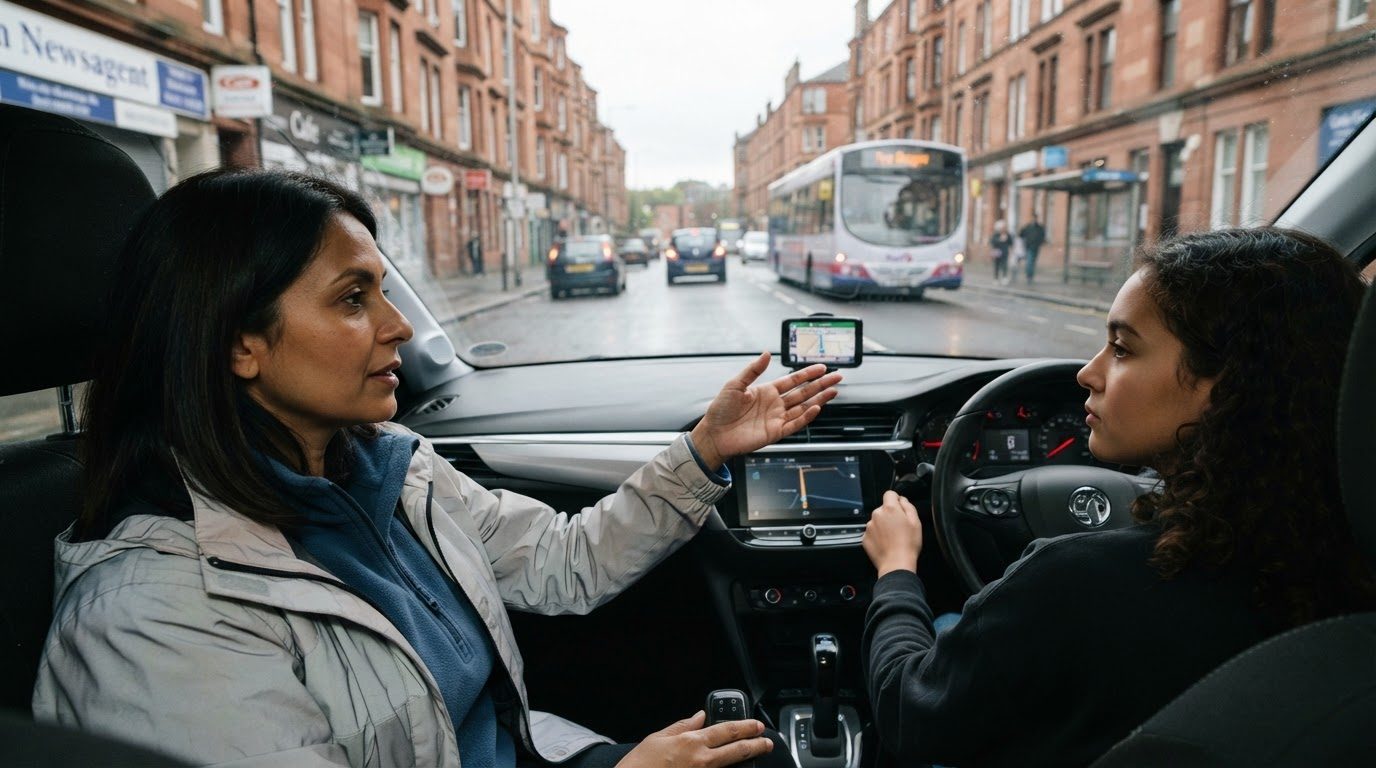
Glasgow is a demanding but valuable place to learn to drive. City-centre traffic, bus lanes, one-way systems, pedestrians and busy junctions require more than basic vehicle control; they demand accurate observation, sound judgement and calm decision-making.
If you are comparing automatic driving lessons glasgow, look beyond the promise of a quick pass. The right tuition should help you become a safe, independent driver who can manage unfamiliar roads, changing traffic and adverse weather—not merely repeat a test route.
topgeardrivingtuition provides automatic tuition with an approach centred on adapting instruction to the learner. That matters whether you are a complete beginner, returning to driving, changing from manual or preparing for a practical test.
A calmer way to learn in Glasgow traffic
An automatic vehicle removes clutch control and routine gear changes. That reduces physical workload and allows learners to concentrate on:
- Mirror checks and blind-spot awareness.
- Lane position and road markings.
- Safe speed selection.
- Junction priorities and gap judgement.
- Anticipating pedestrians, cyclists and parked vehicles.
This does not make driving effortless. Glasgow’s central streets can involve sudden lane changes, restricted bus lanes, delivery vehicles and pedestrians stepping into the road. Multi-lane roundabouts and complicated road layouts also test planning. Automatic tuition simply gives the learner more mental capacity to deal with those demands.
Nervous drivers should expect progress to be gradual. A good instructor may begin with quiet roads, introduce one challenge at a time and use calm, specific feedback. Someone returning to driving may need fewer lessons than a beginner, but confidence and hazard awareness still need to be assessed rather than assumed.
Choosing an automatic also has a long-term consequence: passing the test in an automatic generally results in an automatic-only licence entitlement. If you later want to drive a manual car, you normally need to pass a further practical test in a manual vehicle.
Personalised tuition for different learner needs
Effective instruction starts with an assessment of ability, previous experience and confidence. A structured lesson might include a clear objective, guided practice, independent attempts and a review of what to practise next.
Typical starting points include:
- Complete beginners: vehicle controls, moving off, stopping, steering and basic observations are introduced in a low-pressure setting.
- Manual-to-automatic learners: the focus shifts from clutch and gear management to smooth braking, accelerator control, positioning and anticipating traffic.
- Refresher pupils: the instructor identifies specific gaps, such as roundabouts, motorway joining or parking, rather than repeating skills already secure.
- Nervous drivers: short, achievable tasks and predictable routes can build confidence without overwhelming the learner.
- Test candidates: lessons can target independent driving, manoeuvres, meeting test standards and correcting recurring faults.
Constructive correction is important. “Check the mirror earlier before changing lane” is more useful than vague criticism, while positive reinforcement confirms which decisions were safe and repeatable. Topgear states that it has male and female instructors; availability should be confirmed when booking if instructor preference is important.
What automatic lessons should cover on Glasgow roads
Building core vehicle control
Early lessons should establish reliable routines, not just movement of the car. Learners need to understand the selector positions—normally Park, Reverse, Neutral and Drive—and when to apply the parking brake. They should also practise:
- Smooth acceleration and progressive braking.
- Steering accuracy and appropriate hand positioning.
- Mirror use before speed, direction and position changes.
- Safe moving off and stopping routines.
- Reversing, bay parking, parallel parking and controlled manoeuvres.
- Pedestrian crossings, junctions, roundabouts and lane changes.
An instructor should explain how the car behaves at low speed, including creep in Drive, rather than allowing the learner to rely on guesswork. Dual controls provide an additional safety measure during tuition, but they do not replace active observation by the learner.
Progressing from quieter roads to complex routes
Training commonly develops from quiet residential streets to urban roads, busier junctions, multi-lane roundabouts and dual carriageways. In Glasgow, learners may eventually need experience with the M8, the Clyde Tunnel, the A82 or other high-speed routes, where appropriate to their ability.
Later lessons should include:
- Independent driving using signs and sat-nav directions.
- Hazard perception and anticipation around parked cars, cyclists and crossings.
- Lane discipline on multi-lane roads.
- Joining, leaving and changing lanes on faster roads.
- Test-standard decision-making without instructor prompts.
Weather also matters. Glasgow’s frequent rain increases stopping distances and can reduce visibility through spray. Lessons should address appropriate speed, dipped headlights, demisting, tyre grip and greater following distances. Fog, winter darkness and occasional snow require further adjustment.
Choosing the right lesson format and course pace
Weekly lessons suit learners who want steady progression and time to practise between sessions. Concentrated or intensive tuition may work for someone with a deadline, substantial private practice or previous driving experience, but it can be tiring and may expose weaknesses before they are properly consolidated.
A sensible plan considers:
- Lesson length, commonly one or two hours.
- Frequency and instructor availability.
- Pickup areas and whether travel time reduces tuition.
- Vehicle size, visibility and suitability for the learner.
- Dual controls and the instructor’s qualifications.
- Opportunities for supervised private practice.
There is no universal lesson total. The DVSA has cited an average of about 45 hours of professional tuition alongside 22 hours of private practice, but individual requirements vary considerably. A learner with regular supervised driving may progress faster than someone attending sporadically with no practice between sessions.
Before booking a block or intensive course, ask about cancellation terms, vehicle availability, assessment lessons and what happens if progress is slower than expected. A lower hourly rate is not necessarily better value if inconsistent tuition creates additional hours later.
Preparing for the automatic driving test
The practical test is not simply a demonstration of memorised routes. The candidate must show independent, safe driving in varied conditions, including:
- Effective observations and mirror use.
- Appropriate speed and safe following distances.
- Correct road positioning and lane discipline.
- Competent manoeuvres and controlled stops.
- Independent driving using signs or a sat-nav.
- Timely responses to hazards and changing priorities.
Theory preparation should cover the Highway Code, road signs, stopping distances, vulnerable road users and hazard perception. Starting practical lessons before passing the theory test is generally possible, although candidates need a valid provisional licence and must pass the theory test before booking or taking the practical test.
Mock-test drives can identify weaknesses under examination conditions. Route-specific practice is useful for understanding local junctions and traffic patterns, but familiarity with one route cannot guarantee success; test routes and hazards vary.
Common questions
How much do automatic driving lessons in Glasgow cost?
Prices vary by instructor, lesson length, vehicle and demand. A realistic broad benchmark is approximately £35–£50 per hour, with two-hour sessions and block bookings priced differently. Confirm the current rate, payment terms and cancellation policy directly.
Will learning in an automatic be quicker?
It can be, because clutch and gear changes are removed. However, observation, judgement, manoeuvres and independent driving still require practice. An automatic is not a shortcut through the full learning process.
Can I start lessons before passing my theory test?
Yes, provided you hold the appropriate provisional licence and meet legal requirements. Starting early can help connect theory knowledge with real hazards, but theory study should continue alongside driving.
How do I know when I am ready for the practical test?
You should be able to drive independently across varied roads, manage hazards without prompting, complete manoeuvres consistently and keep faults within an acceptable level during several mock tests. Your instructor should explain any remaining weaknesses clearly.
Can I take refresher lessons after passing?
Yes. Refresher tuition can help with motorway driving, parking, city-centre routes, returning to driving after a break or rebuilding confidence after an incident. It is often more focused and shorter than learner training.
The strongest automatic lessons in Glasgow combine technical control with independent judgement. That approach prepares learners not only for the driving test, but for the unpredictable roads and conditions they will face afterwards.